
The 'Smear Second'
Posted by Nick on 18th Sep 2026
The "Smear Second": A Quieter Way to Fix Time
A while back we wrote about leap seconds — the odd little extra second officially added to world time every so often to keep atomic clocks in step with the Earth's actual rotation. It turns out that fix has a fix of its own, and it's just as strange in its own way: the smeared second, sometimes called a "leap smear."
The problem with a sudden extra second
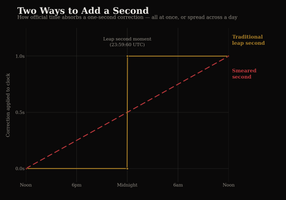
A traditional leap second is abrupt. At a designated moment, official clocks briefly show an extra second — 23:59:60 — before rolling over to the next day. For a person, that's barely noticeable. For computer systems, it can be a real headache. A lot of modern software assumes time only ever moves forward in perfectly even steps, and a sudden repeated or extra second can confuse databases, trigger errors, or cause systems that depend on precise timing to behave unpredictably. This isn't hypothetical — past leap seconds have caused real outages at major technology companies.
The smear: spreading the second out
Rather than inserting the extra second all at once, some of the world's largest technology companies — Google and Amazon among them — instead spread it out gradually. Google's approach, for example, takes the leap second and "smears" it evenly across a full 24-hour window, typically centred around noon. During that day, clocks simply run very slightly slower than normal, by a tiny fraction of a second per second, so slight it falls well within the normal tolerance of the quartz timing components used in computer systems. By the end of the 24 hours, the clock has quietly absorbed the extra second without ever jumping or repeating a moment.
It's a clever bit of lateral thinking: instead of trying to fix an awkward problem with force, you fix it by making it small enough, for long enough, that nothing downstream ever notices.
Why this matters to us as watchmakers
There's something genuinely appealing about this approach if you spend your working life around mechanical timekeeping. A finely regulated watch doesn't correct itself in sudden jumps either — a good watchmaker's job is to get a movement running as smoothly and consistently as possible, so that any tiny variation is spread evenly rather than showing up as an abrupt jolt. The smeared second is essentially the same philosophy applied to the digital world: smooth, gradual correction beats sudden disruption, whether you're talking about a data centre or a balance wheel.
It's a nice reminder that however differently mechanical and digital timekeeping have evolved, the people responsible for both are still solving remarkably similar problems.