
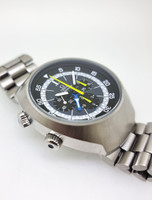
What is a GMT watch?
Posted by Nick on 2nd Oct 2026
GMT Watches: What That Extra Hand Is Actually For
With the travel season starting to ramp up, it's a good time to talk about one of the most genuinely useful complications in watchmaking — the GMT. Most people assume that extra hand and the 24-hour markings around the dial are purely decorative, but a GMT is one of the few complications built entirely around solving a real, everyday problem: knowing what time it is somewhere else without doing mental arithmetic every time someone asks.
What a GMT watch actually does
A standard GMT watch has three things a normal watch doesn't: a fourth hand that makes one full rotation every 24 hours instead of 12, a 24-hour scale printed around the edge of the dial or on the bezel, and often a rotating bezel to go with it. The GMT hand points to a second time, read off that 24-hour scale, while the regular hour and minute hands keep showing local time as normal. In its simplest form, it lets you track two time zones on one watch at a glance.
Not all GMTs work the same way
Here's where it gets genuinely interesting, and where the complication splits into two quite different types of watch.
An "office GMT" (sometimes called a caller GMT) has its hour and minute hands locked together exactly like a normal watch — they move as one unit. The 24-hour GMT hand is fixed to that same movement too. To track a second time zone, you generally rotate the bezel to line up with the GMT hand, and the only way to change which time zone that GMT hand is actually tracking is to adjust all the hands together via the crown, which also shifts your main local time display. It works, but it's a bit of a blunt instrument if you're actually crossing time zones yourself.
A "true GMT" (sometimes called a flyer GMT) does something cleverer: the main hour hand can be set independently, jumping forward or backward in one-hour increments via the crown, without disturbing the minute hand, the seconds, the date, or the 24-hour GMT hand at all. That GMT hand just quietly keeps tracking your home time zone the whole time. Land in a new country, jump the hour hand to local time in a few clicks, and your home time and date are still sitting there correctly on the dial. It's a small mechanical difference that makes a genuinely big difference if you're actually the one doing the travelling, rather than just keeping an eye on a colleague's time zone from a desk.
Why it's worth knowing which one you have
If you're buying a GMT watch to actually use while travelling, the true/flyer mechanism is worth seeking out specifically — it's the version built for people changing time zones themselves, historically developed with pilots and crews in mind. An office GMT is a perfectly good watch, but it's really built for someone tracking a second time zone from one place, not someone jumping between them.
Either way, a GMT is a lovely example of a complication that earns its place on the dial. If you've got one sitting in a drawer that's not currently set correctly, or you're not sure which type yours actually is, bring it in and we'll sort it out and show you how to use it properly.